Rooting Herbs from Cuttings: Five Small Experiments to Learn Propagation at Home
Propagating herbs from cuttings is one of the most satisfying small skills for a balcony or kitchen gardener. It saves money, speeds up your herb supply, and helps you learn subtle cues about plant health. These five experiments are designed to be low-effort, each taking a week or two, and to build your confidence and pattern recognition. Do them with the same herb species (basil, mint, rosemary, or sage) so you can compare easily.
How to run these experiments
Pick one herb and gather 10–15 healthy, non-flowering stems about 3–5 inches long. Label small jars or pots (paper tape works fine). Each experiment lists what to do and what to observe: root appearance, time to first root, leaf yellowing, and whether a rooted cutting survives transplant. Record brief notes each day—just a line for each jar—so you can spot differences.
Experiment 1 — Water vs. Soil: Where do roots appear fastest?
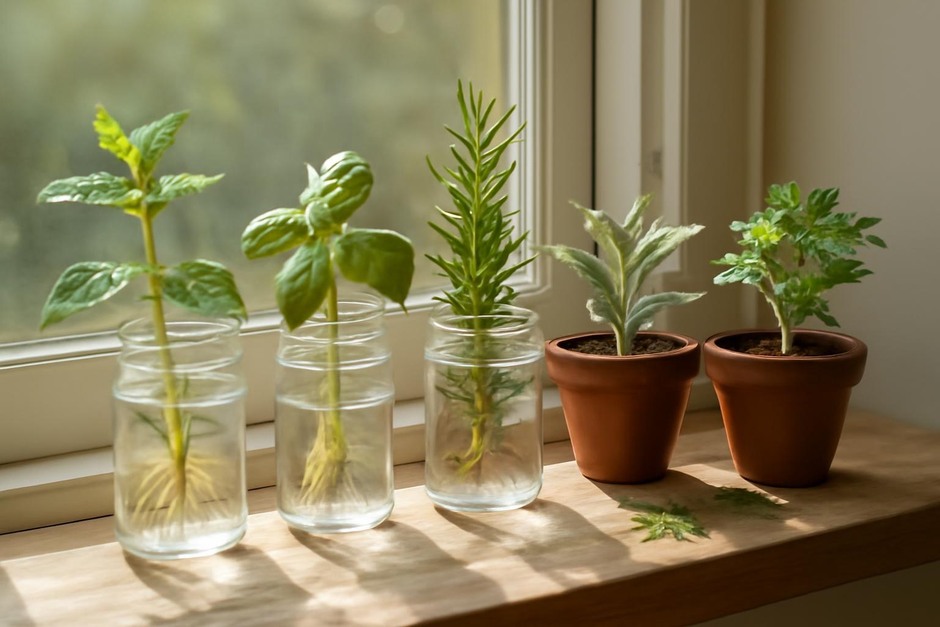
- Place 3–4 cuttings in clear jars of room-temperature water, stems submerged but leaves above water.
- Plant 3–4 cuttings directly into a light potting mix in small pots, inserted so lower nodes are buried.
- Keep water jars on a bright windowsill; keep pots in the same spot and water lightly so the soil stays barely moist.
Observe: Do roots appear sooner in water or soil? Note root thickness and length. Many herbs root visibly faster in water, but soil-rooted cuttings may adapt to potting conditions sooner after transplant.
Experiment 2 — Cut Length and Leaf Removal
- Try two lengths: short (2–3 inches) and long (4–5 inches). For each length, try removing the lower leaves so two nodes are bare or leave some lower leaves intact.
- Use the same medium that worked best in Experiment 1, to keep one variable at a time.
Observe: Which length produces steadier roots? Do removed lower leaves reduce rot and speed rooting? Many herbs root better when lower leaves are removed because buried leaves rot and invite disease.
Experiment 3 — Bottom Heat and Light
- Compare a warm spot (above a radiator or on a seedling heat mat set low) with a cool bright windowsill.
- Also compare indirect light (east window) with stronger light (south-facing, filtered through a curtain).
Observe: Does gentle warmth speed root development without stressing leaves? Most Mediterranean herbs (rosemary, thyme) tolerate bright light but may need steadier warmth for good root growth.
Experiment 4 — Hormone or No Hormone
- Dip the base of half your cuttings into a rooting hormone (powder or gel) and plant/run them the same way as untreated cuttings.
- Keep conditions identical otherwise.
Observe: Some herbs (woody stems like rosemary) show clearer benefits from hormone; soft-stem herbs (basil, mint) often root readily without it. Note not just speed, but survival after transplant.
Experiment 5 — Transplant Test
- When roots are 1–2 inches long, transplant half your rooted cuttings into small pots with potting mix and leave the other half in water or original soil to continue growing for comparison.
- Watch for transplant shock over the next two weeks: slowed growth, yellowing, or recovery and new shoots.
Observe: Which preparation method led to plants that adapted fastest after transplant? This step tells you which rooting method produces truly usable plants for your balcony containers.
A short, repeatable routine to use after the experiments
After you complete these experiments, adopt this simple routine whenever you take cuttings:
- Select healthy, non-flowering tips about 3–4 inches long.
- Remove lower leaves so two nodes are bare; use water rooting for quick visual feedback or soil if you prefer fewer transfers.
- Keep cuttings bright but out of harsh midday sun; provide gentle bottom heat if your indoor temps stay below 65°F (18°C).
- Record the date you took cuttings and when roots first appeared; transplant when roots reach about 1 inch.
- Harden off new plants for a few days if moving outdoors: morning sun and shaded afternoons for several days.
These small experiments teach you how your specific herbs respond to local light, warmth, and care. Repeat any experiment if results were mixed—the goal is a short cycle of trial, note, and adjustment. Within a season you’ll gain a dependable method for multiplying the herbs you love.
Quick tip: Do experiments in small batches so a few failures feel ordinary and informative. Successful propagation often comes from noticing small differences and keeping the routine simple.