Pinch, Snip, Repeat: Five Small Experiments to Train Bushier Herb Plants
Question
How much and how often should you pinch or trim a container-grown herb to get a bushier plant without stressing it? These studio-style notes use five small experiments you can run on common herbs (basil, mint, oregano, thyme) to develop an instinct for where to cut, how often, and what to expect.
Process
General setup: choose 3–6 healthy, similarly sized plants of the same species, grown in similar light and soil. Label them. Work with one or two stems per plant so each experiment is small and reversible. Record dates, weather/light conditions, and short weekly notes.
Experiment 1 — The Control and the First Pinch
- Goal: see baseline growth vs a single early pinch.
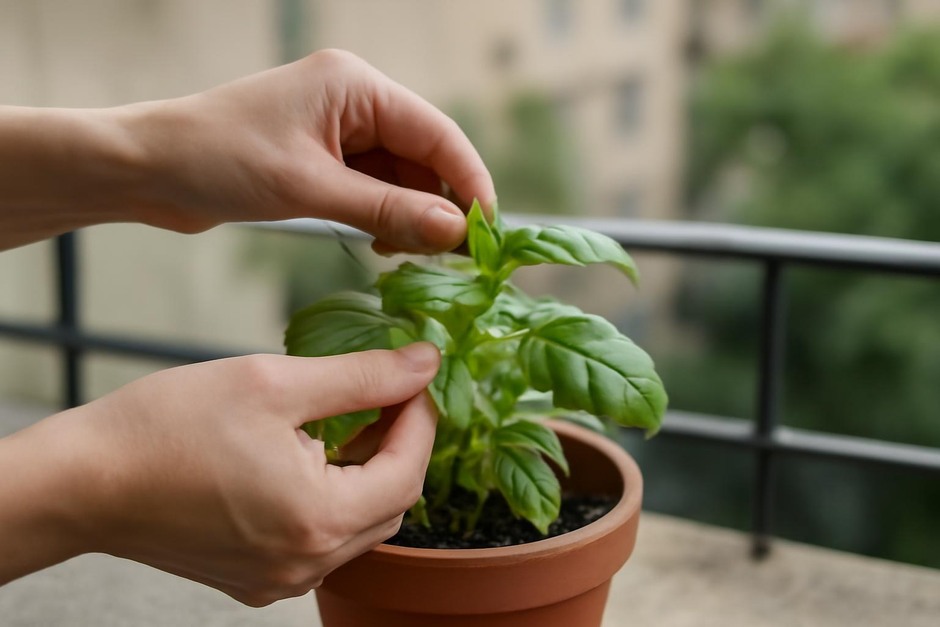
- Method: keep one plant unpinned (control). On another plant, pinch the top after 4–6 true leaves, removing the growing tip just above the next node.
- Observe: new side shoots after 7–14 days, internode length, and overall shape at 3–4 weeks.
- What you’ll learn: whether this herb responds quickly to a single tip removal and how much branching to expect.
Experiment 2 — Pinch vs Scissor Cut
- Goal: test whether pinching by hand or cutting with scissors affects regrowth.
- Method: on two similar stems, remove the tip on one with a pinch and on the other with a clean scissor cut at the same node.
- Observe: signs of damage, rate of new shoots, and any browning at cut sites over 2–3 weeks.
- What you’ll learn: whether your fingers are gentle enough or a sharp tool gives neater regrowth.
Experiment 3 — Frequency: Weekly vs Every Three Weeks
- Goal: find a rhythm that encourages compact habit without depleting the plant.
- Method: on two matched plants, pinch two shoots weekly on one, and pinch only every three weeks on the other.
- Observe: overall fullness, leaf size, and any signs of stress like yellowing or flop after 4–6 weeks.
- What you’ll learn: how sensitive the herb is to repeated tip removal and whether frequent light pinching beats infrequent heavier pruning.
Experiment 4 — Harvest Style: Leaf-Picking vs Stem Cutting
- Goal: compare routine culinary harvesting (taking leaves) with cutting whole stems.
- Method: on one plant remove several leaves from top nodes; on the other cut the top 1–2 inches (2–5 cm) of stem above a node.
- Observe: flavor concentration (note: sensory observations only), recovery speed, and new shoot formation over 2–4 weeks.
- What you’ll learn: which harvesting method supports steady regrowth for your cooking routine.
Experiment 5 — Pinch Higher vs Pinch Lower
- Goal: learn how node position affects branching and plant shape.
- Method: on two similar shoots, remove the tip on one just above the topmost node (high pinch) and on the other remove it two nodes lower (low pinch).
- Observe: number of new shoots, spacing between nodes, and whether bushiness is concentrated near the top or along the stem over 3–5 weeks.
- What you’ll learn: whether aiming lower produces more overall branching or just spreads regrowth differently.
Review
After 4–6 weeks, compare your notes and photos. Look for consistent patterns: which method produced the most side shoots? Which led to smaller, tighter internodes (a sign of a compact plant)? Did frequent gentle pinching keep plants bushy without stressing them? Did cutting with scissors give cleaner regrowth than pinching?
Tips from the mini-lab:
- Pinch above a node: always remove the tip just above a leaf node to encourage that node to send up new shoots.
- Don’t remove more than a third: avoid heavy removal all at once—gradual shaping is kinder to the plant.
- Keep tools clean: a quick wipe with alcohol prevents transferring pathogens when you use scissors.
- Adjust for species: tender herbs like basil respond fast to pinching; woody herbs like thyme respond more slowly and need gentler, less frequent cuts.
- Light matters: if the plant stretches (long internodes), give it brighter light rather than more pinching to force compact growth.
Next steps: repeat the most promising method on larger sample sizes and across seasons. Over time you’ll build a simple rule set for each herb: how to pinch, how often, and where to harvest for steady, bushy growth. These small experiments are low-risk, easy to reverse, and teach you to read a plant’s response rather than rely on a single rule for all herbs.
Notebook prompt: for each experiment entry, write the date, what you removed (node number or length), one short sentence on new shoots at 7 days, and a final note at 28 days. Those four lines will fast-track your pruning instinct.